The apiary
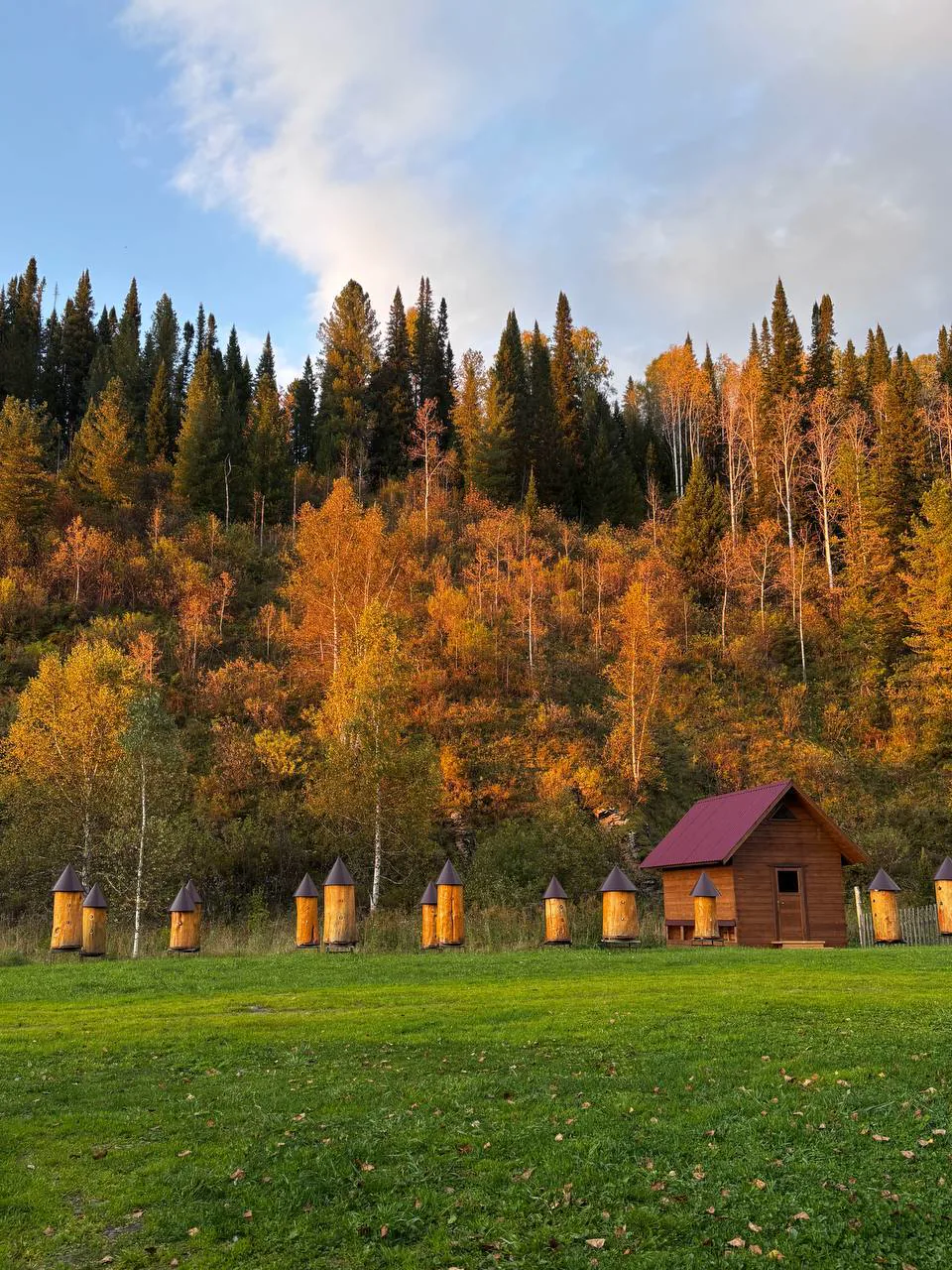
A single family apiary at the edge of the Altai taiga
The honey that replaces your 3 p.m. espresso.
Our honey is harvested at one family-run apiary in the Altai Republic, near Lake Teletskoye, a UNESCO-protected biosphere zone in southern Siberia, with no large factories or mining works anywhere near it. Around 200 hives. One season per year. One source for every lozenge we make. This page is where that source has a face.
Why here
What this place gives the honey
“Russian honey” is not one thing. Altai mountain honey is its own category, defined by altitude, flora, and isolation. Three traits make this region different from European or commercial honey-producing zones.
01 — Isolation
No heavy industry around the reserve.
The apiary sits in the foothills of the Altai Mountains, inside the buffer zone of the Altaisky Biosphere Reserve. There are no large factories or mining works around the reserve, which is exactly what keeps the ecosystem this well preserved. No major roads, no agriculture at industrial scale, no pesticide-sprayed fields within drone range. This matters because honey concentrates whatever the bees encounter, toxins included.
02 — Wildflower forage
Mixed taiga forage, no monoculture.
Bees in this area work wild meadows of the eastern Altai foothills: clover, fireweed, milk vetch, motherwort, mountain mint, alpine sweetgrass, sainfoin. No single nectar source dominates. The honey is polyfloral by default: dark amber, slow to crystallise, with the full enzymatic and mineral profile of raw mountain honey.
03 — UNESCO protection
Part of the “Golden Mountains of Altai” UNESCO World Heritage zone.
The Altaisky Reserve and Lake Teletskoye were inscribed by UNESCO in 1998. The status prohibits industrial extraction, large-scale agriculture, and chemical treatment of the land. For us this is not a marketing label: it is the legal regime that keeps the bee forage clean year after year.
The work
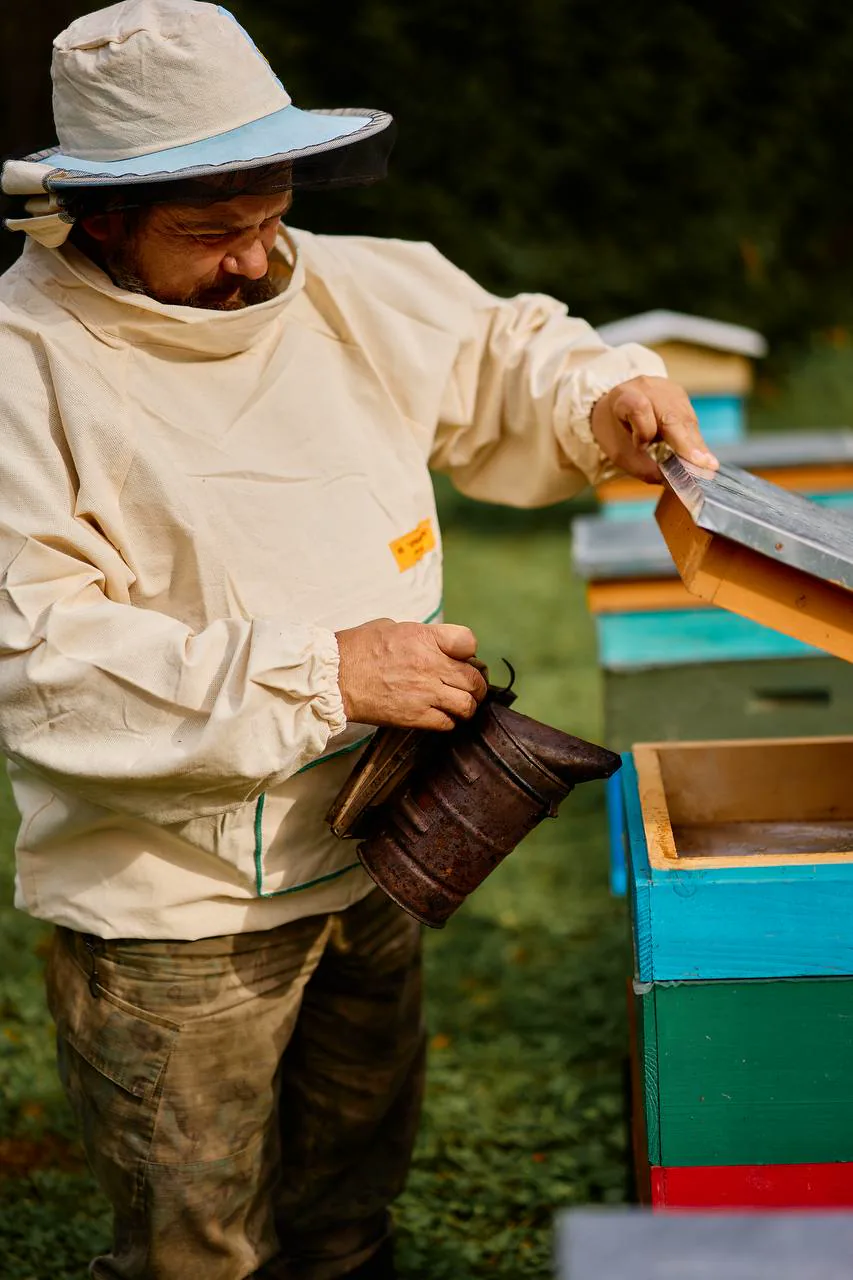
Smoke, suit, slow inspection.
Honey is what you collect. Beekeeping is what you do for the rest of the year. The colonies here are inspected by hand every spring and autumn, frame by frame, hive by hive. We use the same wooden hives, the same hand-rolled smokers, and the same slow-frame inspection method that Siberian beekeepers have used for four generations.
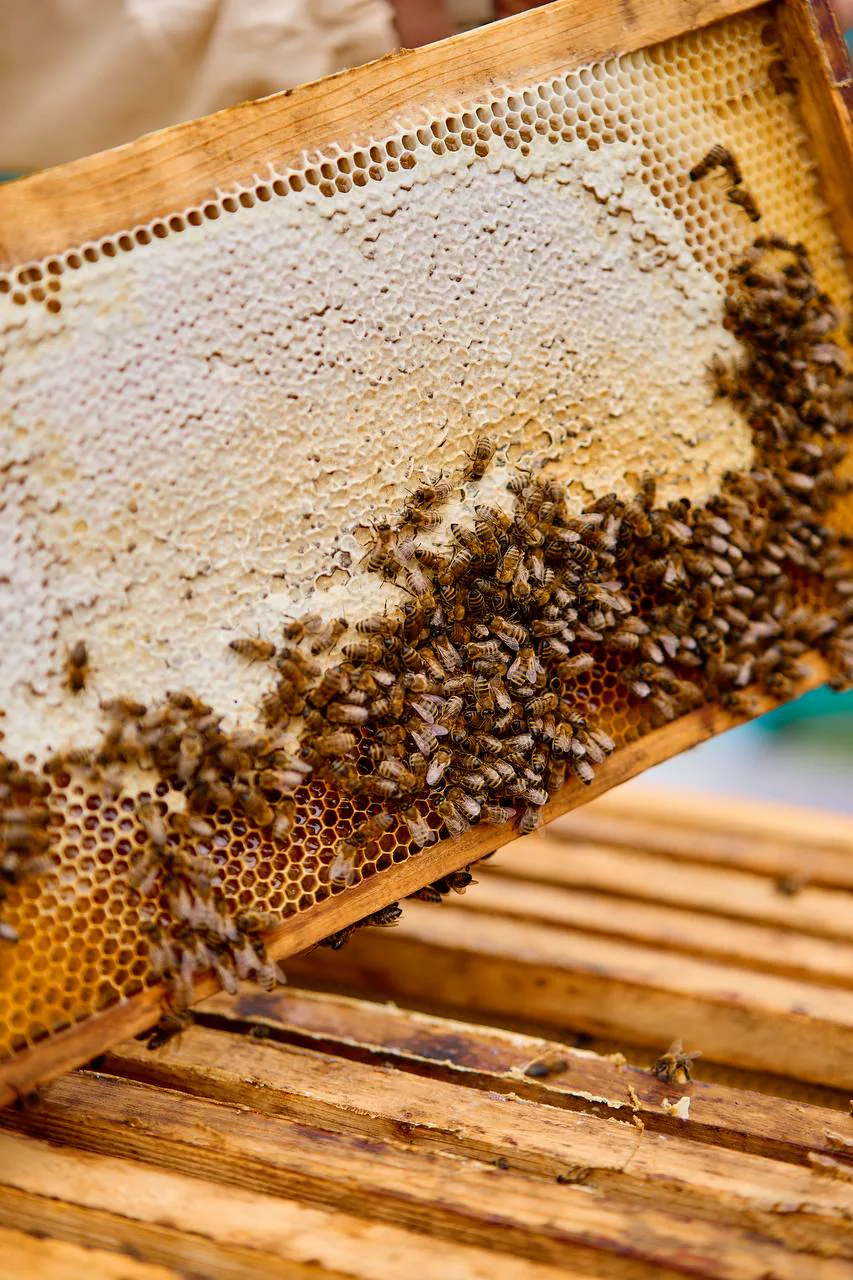
No automation. No high-pressure extraction. No heated decrystallisation. The honey comes out of the comb the way the bees built it: raw, unfiltered beyond a single coarse mesh that removes wax debris, kept below 40 °C as a raw ingredient before production.
This is the only way the diastase activity, the live enzymes, and the trace pollen profile survive intact into the jar. It is also the reason each hive yields about 36 kg a season, roughly seven tonnes a year across the apiary, not the volume an industrial operation would push.
The harvest
One season. One harvest. No blending.
Altai has one honey season. It begins in late June, when the first taiga flowers open in the high meadows, and ends in mid-August, when the nights cool and the colony slows foraging. Inside that window, frames are pulled twice (once mid-season, once at the end) and only fully capped honeycomb is taken. Uncapped frames are left for the bees to overwinter on.
Every jar of honey that becomes a Nature’s Recipes lozenge can be traced back to a specific harvest, in a specific year, from this specific apiary. There is no buffer stock from anonymous suppliers, no “winter-stretch” blending, no industrial honey added to extend volume. When the season’s allocation is gone, production pauses until the next harvest.
The bees, in return, keep the honey they need. We do not feed colonies sugar syrup to push winter survival or extract more in spring, as is common practice in commercial beekeeping. Colonies overwinter on their own honey, the way they did before industrial apiculture existed.
Slow by design
What we do not do.
- No antibiotics in the colonies. Ever. Inspections find disease the old way: by eye, by smell, by frame health.
- No sugar feeding to stretch winter survival or boost spring output.
- No heat treatment. Honey leaves the comb raw and is jarred raw.
- No chemical mite control. Hives are managed with thermal and organic acid methods accepted by EU organic standards.
- No blending across apiaries, seasons, or origins. One apiary. One harvest.
This is the slow path. It costs more. It produces less. It is the only way the honey going into your lozenge is the honey we say it is.
This is the honey that becomes your daily lozenge, about 90 % of every one.
The chain
From frame to lozenge in four steps.
Every Nature’s Recipes lozenge is roughly 90 % this honey. Here is what happens between the comb and the foil pouch.
01
Harvest
Frames pulled at the apiary. Honey extracted cold, coarse-filtered, jarred at the apiary outbuilding.
02
Transport
Sealed jars shipped around 250 km to the Biysk production facility: refrigerated truck, single hop, no warehousing.
03
Formulation
Honey blended at low temperature with wild-harvested Leuzea and Red Root root powders (≈5 % each). Pressed into lozenge form. No heat, no sugar, no fillers.
04
Testing & release
Tested by an independent, accredited laboratory for heavy metals, antibiotics, pesticides, microbiology and HMF.
For the full standards and test panel see Quality & sourcing.
Why this matters for you
From this ridge to your 3 p.m.
Before this honey becomes your morning lozenge, it spends a season here. Clean, raw, single-source honey is what lets the two Altai roots, Leuzea and Red Root, do their work: steady resistance to fatigue, without the spike and crash of caffeine. That is the difference you are meant to feel by mid-afternoon, on the days that used to need a third coffee.
And because clean is the whole point: the lozenge is raw honey, two plant-root extracts and beeswax, with no alcohol, no pork, no gelatin. SFDA halal certification is in progress; we would rather tell you where we stand than show a badge we have not earned.